MAGICAL PLUG.
A social-commerce product experience designed around responsive discovery feeds, interactive media cards, and clean frontend component modularity.
Magical Plug was conceived as a digital exploration of social-commerce—bringing together product discovery and dynamic social content within a cohesive, responsive web application.
Traditional e-commerce platforms often isolate product catalogs into rigid tabular grids. Magical Plug was designed to investigate whether an interactive, feed-driven discovery model could make browsing feel more engaging, fluid, and intuitive across devices.
I engineered the complete frontend interface and the accompanying backend service layer:
Designed and coded dynamic card elements that display product details, visual media, and interactive state transitions seamlessly.
Ensured layout integrity across narrow 320px mobile viewports up to wide desktop screens without breaking horizontal containment.
Structured reusable UI elements (cards, navigation pills, media containers) into predictable, state-managed React components.
Created backend endpoints using Express to serve structured product metadata and catalog data to the frontend.
The application is built around a lightweight decoupled structure:
React for UI Rendering: The interface uses React functional components and hooks to manage local presentation state, active slide indexes, and discovery filtering without unnecessary re-renders.
CSS Grid and Flexbox: Custom CSS architecture ensures that card grids reflow naturally across breakpoints without heavy third-party UI libraries, maintaining fast loading times.
Express Routing: Node.js and Express handle catalog routes and deliver structured JSON payloads cleanly to the client application.
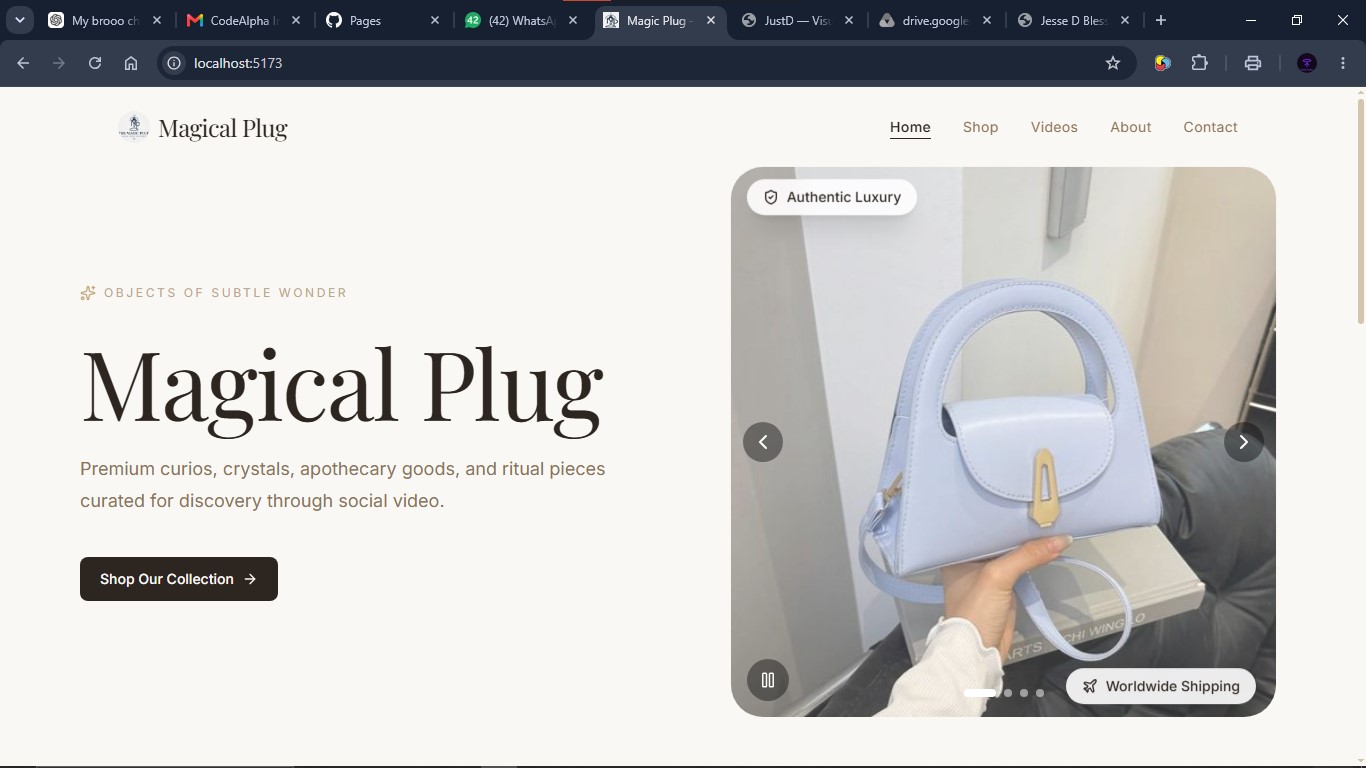
Balancing Media Density with Layout Stability: Social-commerce feeds rely heavily on visual assets. Maintaining layout stability and avoiding layout shifts (CLS) required explicit aspect ratios on image containers and asynchronous loading.
Small Screen Optimization: Creating an expansive editorial feel while maintaining touch usability on screens as small as 320px required strict container containment, touch targets of at least 44px, and adaptive typography clamps.
Building Magical Plug reinforced the value of clean component breakdown and disciplined state management. Exploring feed-based UI highlighted how small interactive touches—like responsive image switching and instant layout reflows—directly impact user engagement in modern web products.
It also solidified my approach to frontend development: prioritizing clean semantic structure and CSS fundamentals before reaching for external dependencies.
Magical Plug was developed as an exploratory interactive prototype. Code and architectural artifacts are maintained within Jesse D Bless's developer portfolio repositories.